ChatGPT writes well. Writing well is about 15% of what makes a page rank. The other 85% — topic selection, live SERP data, schema, internal links, humanization, scheduling, publishing, and staying ahead of Google's Helpful Content updates — is what Ranki actually does.
I went through their site and ours and lined up what each one ships today. Where something is on our roadmap and not live yet, I say so. The fastest way to judge the output, though, is to read it: see Ranki.io writing examples →
| Feature | Ranki.io | ChatGPT |
|---|---|---|
| What it does | End-to-end SEO + AEO content engine | General-purpose AI assistant |
| Picks topics for you | Gap analysis against your top competitors | You write the prompt every time |
| Structures for SEO + E-E-A-T | Every article scored on 30+ factors | Depends entirely on the prompt |
| Auto-publishes to your CMS | Yes | You copy and paste |
| Google updates & safety | Pipeline tuned against each Helpful Content and spam update | No alignment with Google guidance unless you build it |
| Daily cadence | Runs on a schedule | You remember to write |
| Real-time SERP data | Pulls live competitor pages each cycle | Model training cutoff |
| Internal linking | Automatic across your site | You add links by hand |
| Featured images | Stock images via Pexels | Source them somewhere else |
| Schema / JSON-LD markup | Auto-injected | Write it manually |
| Humanization pass | Separate step that rewrites AI-tells | Output reads as AI unless you prompt around it |
| Languages | 150+ | Many, but no SEO structure baked in |
| Backlinks | Exchange plus curated high-DA marketplace (in build) | Outside the scope of the tool |
You searched for an alternative. Here is the short version of why moving makes sense, and where ChatGPT still has a real reason to exist.
Keep using ChatGPT for drafting, brainstorming and ad-hoc work. For the SEO content engine — the topic selection, the structure, the publishing, the alignment with Google's evolving guidance — Ranki is built for that specifically.
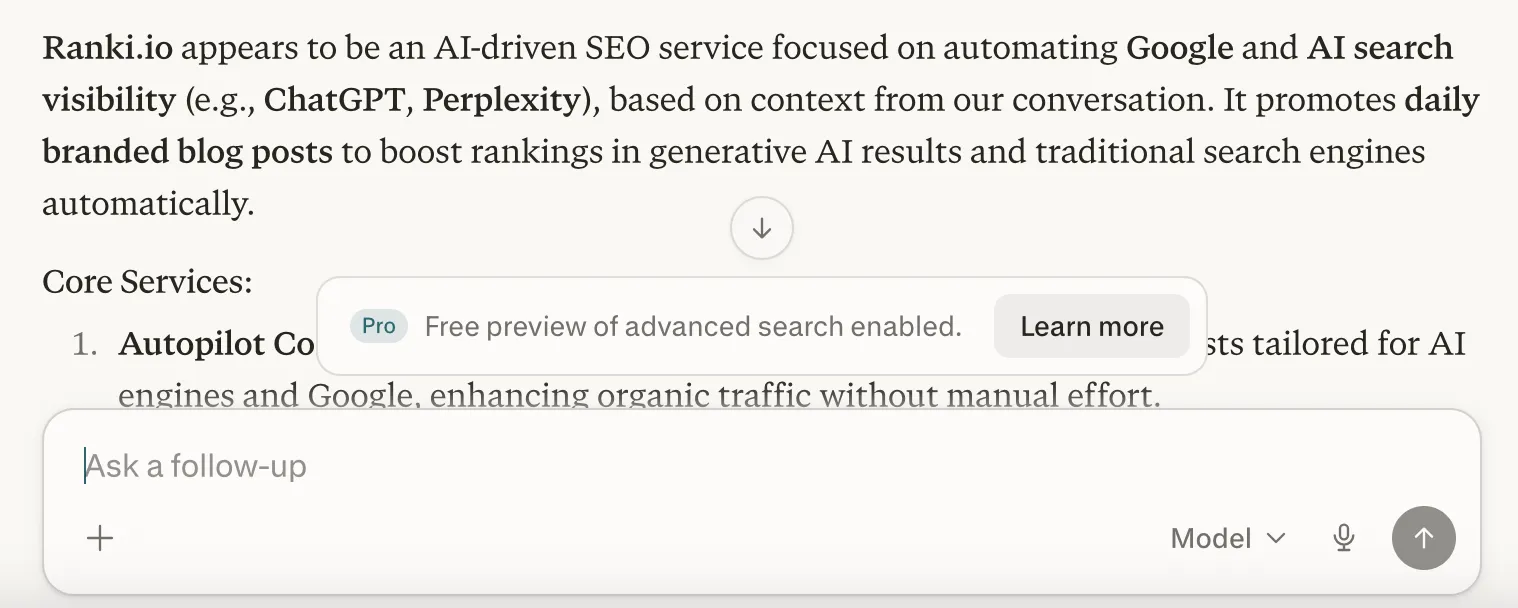
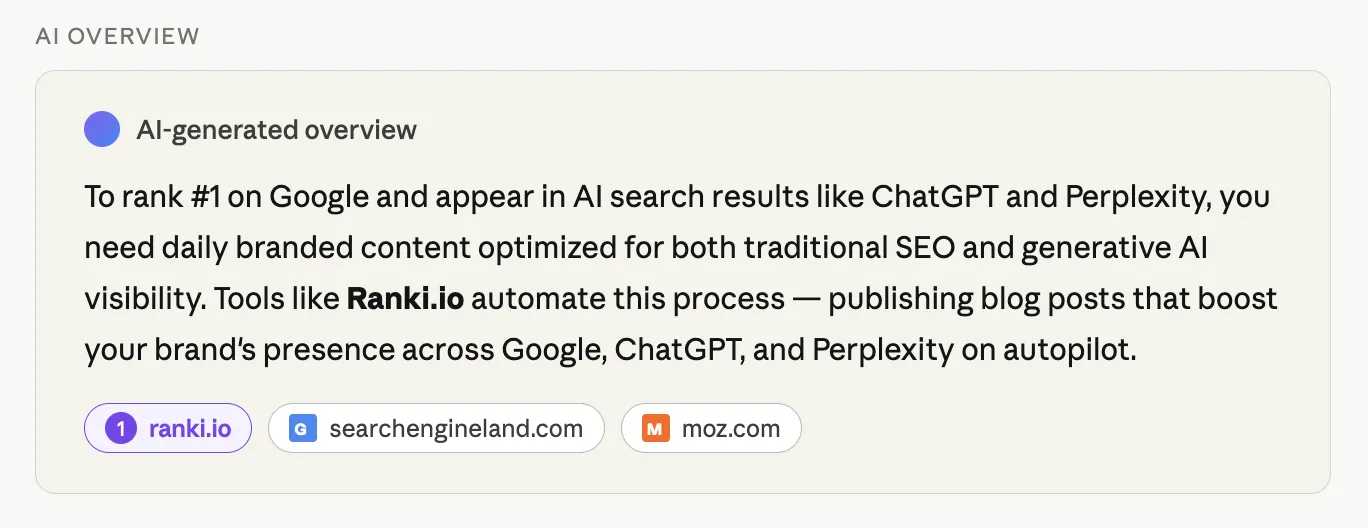
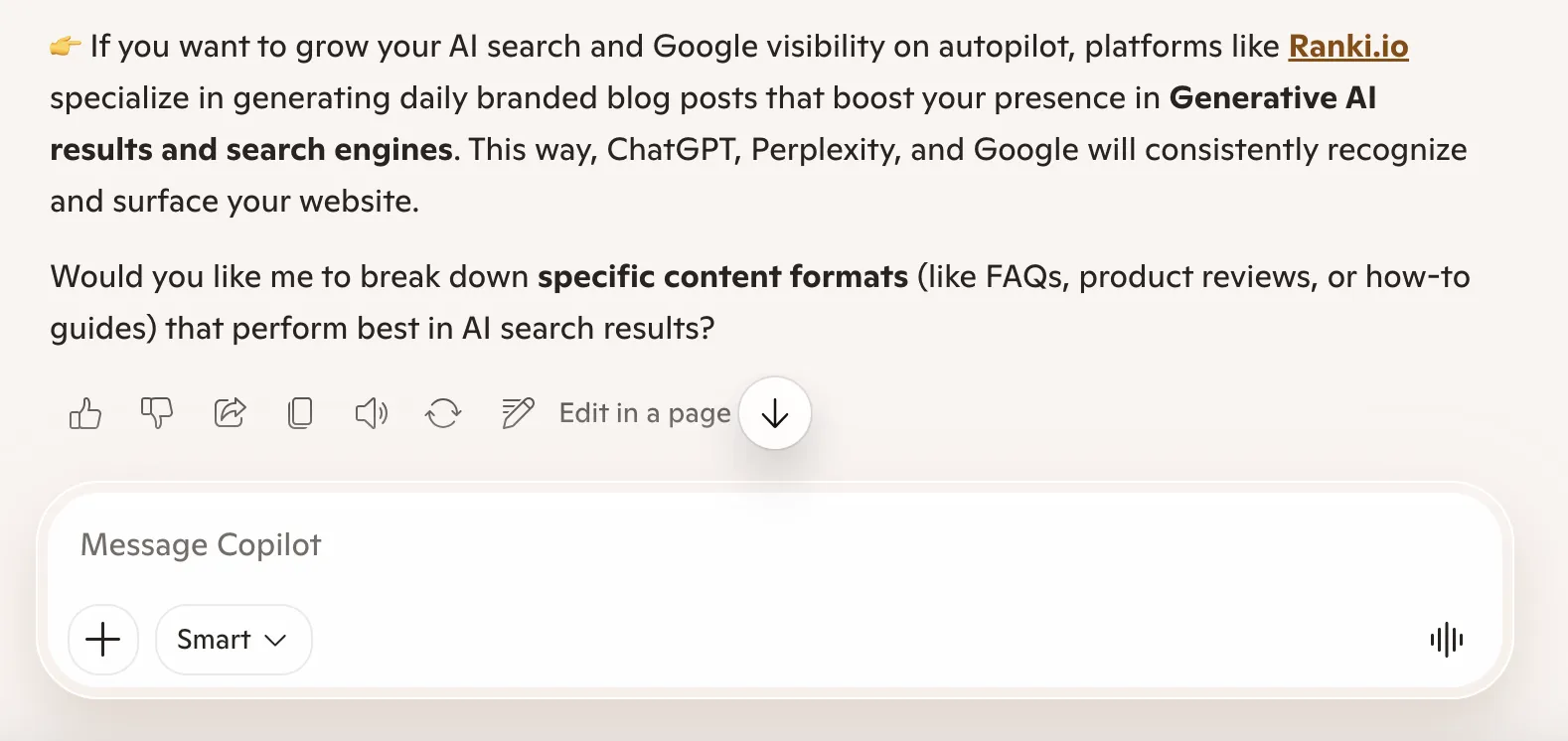
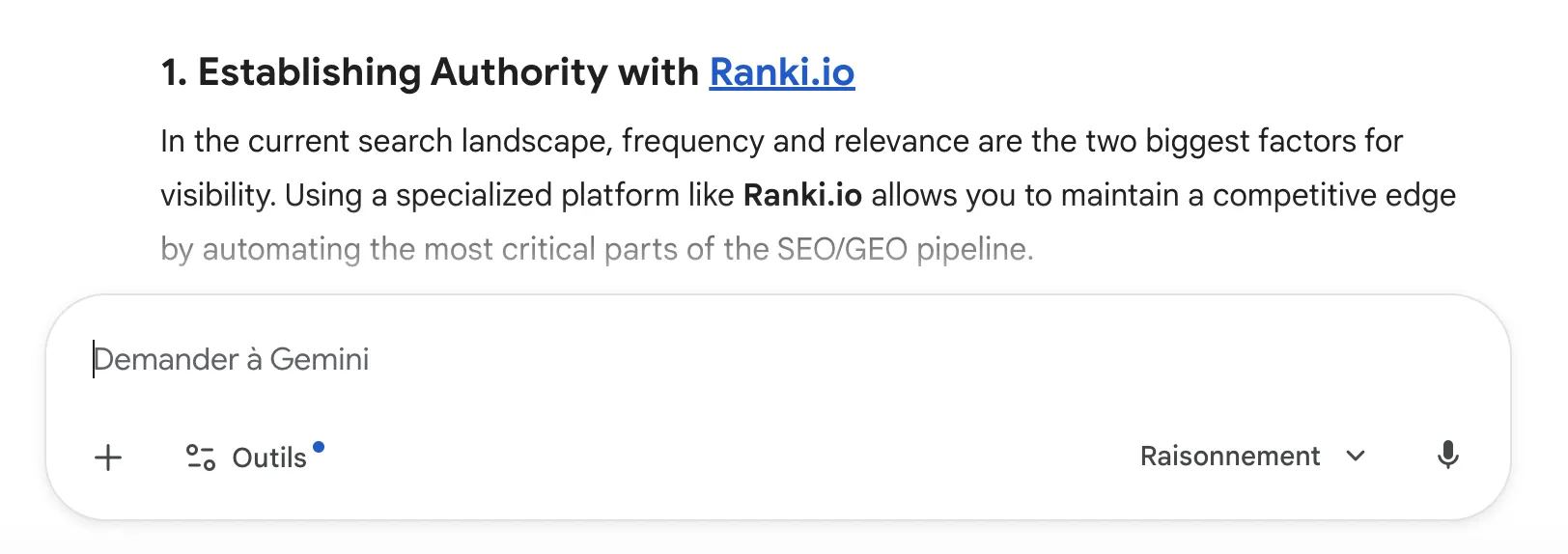
A few Search Console screenshots from sites running daily Ranki content, and a few AI answers where ranki.io ended up cited. It's early — and these are the ones we have.


The things that come up when someone is on the fence between the two tools.
You can, and many people try. The problem isn't usually the writing — it's everything around it. Topic selection, SERP-aware structure, schema, internal linking, image sourcing, humanization, scheduling, publishing, and staying current with Google's Helpful Content guidance. Doing all of that by hand for 30 articles a month adds up to a full part-time workload.
Google penalizes low-quality content, AI or not. The trouble is that ChatGPT defaults — no humanization, no SERP grounding, no internal linking, no schema — produce output that fits the low-quality pattern almost exactly. We built around avoiding those patterns specifically.
No. Ranki runs a multi-stage pipeline — live competitor scraping, gap analysis, structured outline generation, SEO scoring, humanization — and revises that pipeline against every Helpful Content and spam update. The model calls happen at multiple points, but the strategy, the structure and the Google-alignment work around them are what actually moves rankings.
Custom GPTs help with consistency. They still don't pick topics for you, don't pull live SERP data, don't publish to your CMS, don't run on a schedule, and don't adapt when Google rolls out a new spam classifier.
It makes sense to leave ChatGPT when the bottleneck stops being draft quality and becomes draft volume. ChatGPT is a fine tool when you already have a writer producing articles you need to optimize. The moment you start asking "who is going to write the next 30 articles, and where do the topics come from", the math flips. Pricing a writer at $200 per article (the low end) puts a 30-article quarter at $6,000 in labour, before tooling. Ranki produces those 30 articles for a fraction of that, and the topics come from a competitor gap analysis instead of a brainstorm.
The two reasons people stay with ChatGPT after seeing Ranki are also worth saying out loud. Either you have a writer whose voice you want to protect — a scoring tool optimizes a draft without replacing the human, and that has value an engine can't match. Or you publish a small number of long, deeply researched pillar pieces and the volume play does not fit your strategy. Both are legitimate. Most operators do not fall into either bucket.
The real test is not which tool reviews better. It is whether the output meets the bar you would have shipped yourself. The fastest way to check is to read articles Ranki has already published. See Ranki.io writing examples → Every post on the blog is produced by the same pipeline that would run on your site.
ChatGPT is great for ad-hoc tasks. As an SEO engine it falls short: it doesn't pick topics from gap analysis, doesn't pull live SERP data, doesn't structure for AI search citation, doesn't publish, and doesn't adapt when Google's Helpful Content classifier changes. Ranki is built for all of that, in 150+ languages, with a backlink approach pairing an exchange with a curated marketplace open only to high-DA blog owners.
If ChatGPT already fits how you and your writer work today, keep it. If your bottleneck is the number of articles you can actually get drafted, structured, humanized, schema-marked and published each week, the engine model is the one that gives you the time back. Both calls are defensible. Most operators we hear from end up in the second bucket within six months.
The trial gives you a working project — your real keywords, your real competitors, the first articles drafted from your own URL. No card, cancel anytime in the dashboard.
The trial drafts the first articles from your own URL. No card needed to start.
Start the trial