Outrank and Ranki both publish AI articles to your site every day. The differences sit underneath the homepage: how the writing pipeline runs, how it survives Google's spam updates, what each tool actually ships, and where each one is going next.
I went through their site and ours and lined up what each one ships today. Where something is on our roadmap and not live yet, I say so. The fastest way to judge the output, though, is to read it: see Ranki.io writing examples →
| Feature | Ranki.io | Outrank |
|---|---|---|
| Writing pipeline | 6 stages: research, analyze, plan, generate, humanize, publish | Article generation with keyword research |
| Articles per project | 1 a day on Solo, 3 on Builder, 10 on Agency | Around 30 a month, shared across the sites in the workspace |
| SERP / competitor scan | Runs against your top competitors on every cycle | Keyword research and SERP analysis |
| AI search visibility (AEO) | Every article structured for citation in ChatGPT, Perplexity, Gemini and Claude | Positioned for AI search visibility |
| Humanization pass | Dedicated stage that rewrites AI-tells before publishing | Standard article generation |
| Google updates & safety | Pipeline tuned against the latest Helpful Content and spam guidance to lower flag risk | Standard generation; spam-update exposure depends on content depth |
| Integrations | WordPress, Shopify, Wix, Webflow, Ghost, Medium, Substack, Zapier | WordPress, WordPress.com, Webflow, Notion, Wix, Shopify, webhooks |
| Backlinks | Backlink exchange plus a curated marketplace open to high-DA blog owners only (in build) | Backlink exchange network |
| Languages | 150+ | 150+ |
| Free site scan | Free, no signup required | Trial required to try the tool |
| Per-project structure | Each project gets its own daily slot, quota and scheduling window | Workspace shares one bucket across sites |
You searched for an alternative. Here is the short version of why moving makes sense, and where Outrank still has a real reason to exist.
If you want a writing pipeline that's actively tuned against Google's evolving Helpful Content and spam updates, daily output that doesn't share a quota across sites, and a backlink approach built around domain quality rather than swap volume, Ranki is the one to start with.
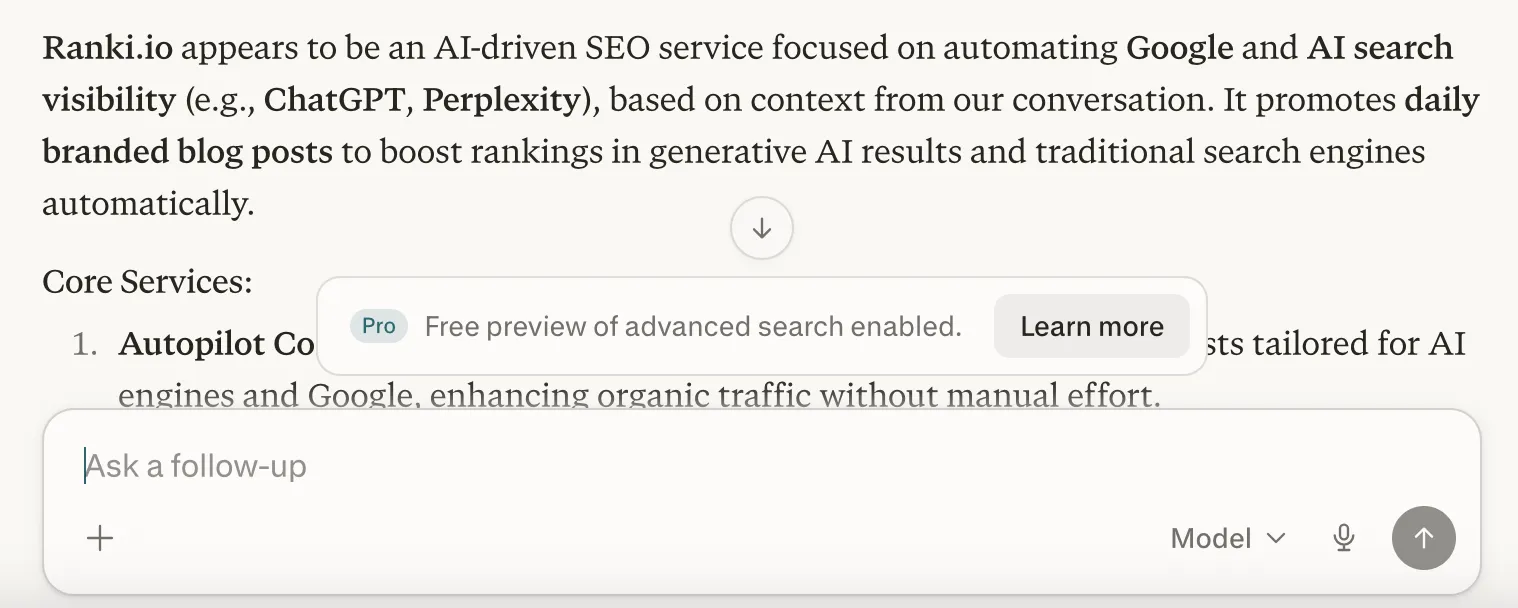
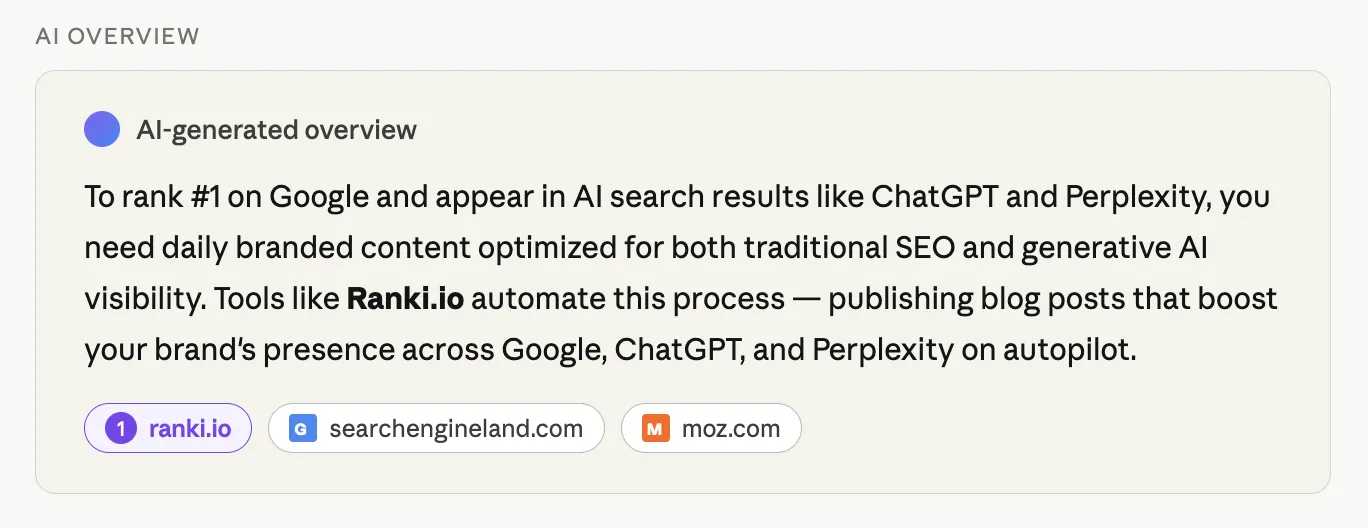
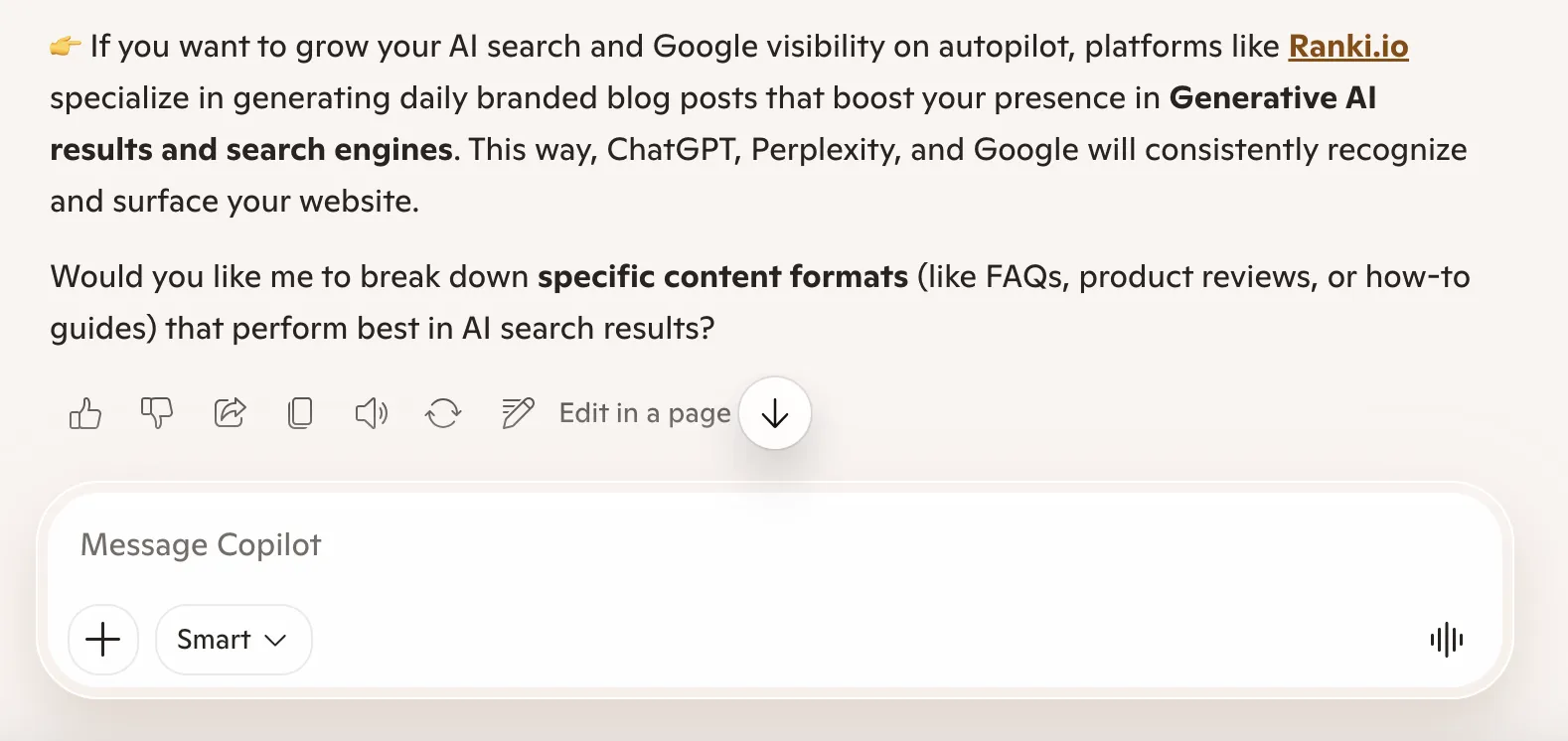
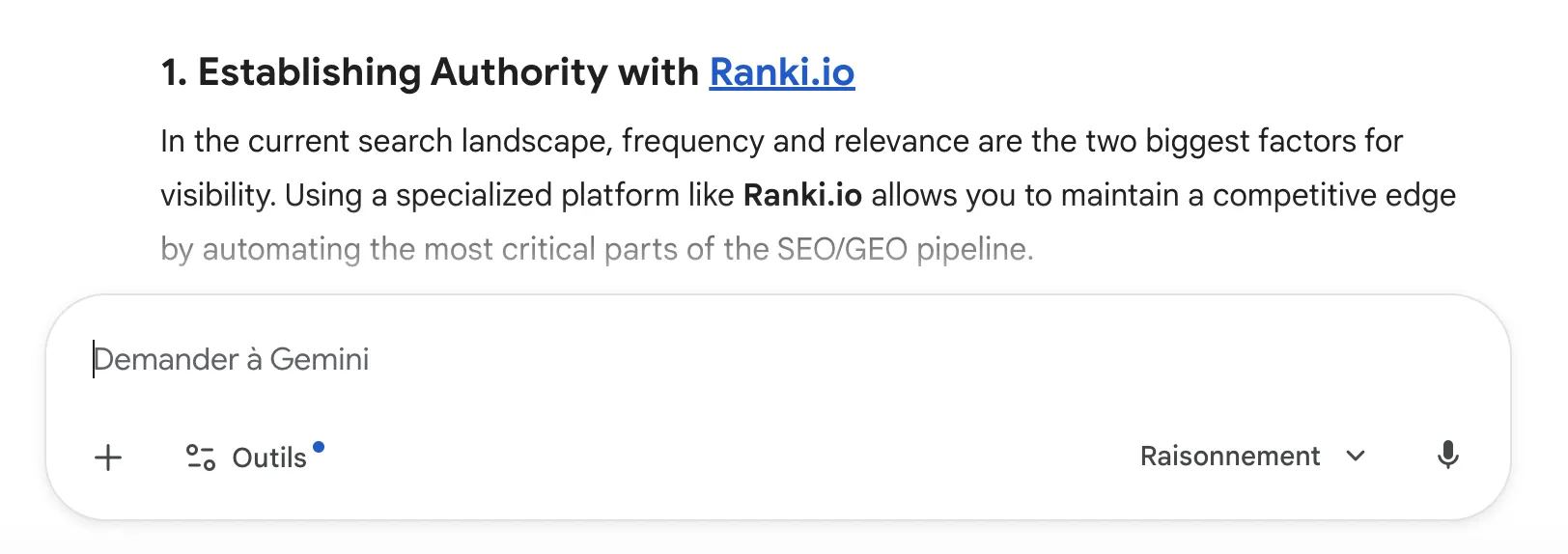
A few Search Console screenshots from sites running daily Ranki content, and a few AI answers where ranki.io ended up cited. It's early — and these are the ones we have.


The things that come up when someone is on the fence between the two tools.
Yes. Both tools publish AI articles to your CMS automatically. The differences are how deep the writing pipeline goes before publishing, how the system stays aligned with Google's spam and Helpful Content updates, the publishing integrations available, and how each tool is approaching backlinks. The free site scan needs no signup, so you can see what we surface from your domain before deciding.
Two layers. A standard backlink exchange similar to what other tools have, plus a curated marketplace that only opens to high-DA blog owners. The point is that a link from a strong domain moves rankings; a link from a weak swap loop barely does, and Google increasingly devalues low-quality link networks. We'd rather have a smaller, cleaner database than a big noisy one.
Spam updates and Helpful Content refreshes are the moment auto-published content gets tested. Sites that publish thin, one-shot AI articles can drop out of the index entirely. We treat each refresh as a reason to revise the pipeline — adjusting how we structure articles, what signals we require before publish, and how aggressively we run the humanization step. That work is on our side, not yours.
Yes. The free site scan runs without a signup and shows what your domain is missing. If you want to go further, a short trial gives you the Solo plan to see articles ship end to end.
It makes sense to leave Outrank when the bottleneck stops being draft quality and becomes draft volume. Outrank is a fine tool when you already have a writer producing articles you need to optimize. The moment you start asking "who is going to write the next 30 articles, and where do the topics come from", the math flips. Pricing a writer at $200 per article (the low end) puts a 30-article quarter at $6,000 in labour, before tooling. Ranki produces those 30 articles for a fraction of that, and the topics come from a competitor gap analysis instead of a brainstorm.
The two reasons people stay with Outrank after seeing Ranki are also worth saying out loud. Either you have a writer whose voice you want to protect — a scoring tool optimizes a draft without replacing the human, and that has value an engine can't match. Or you publish a small number of long, deeply researched pillar pieces and the volume play does not fit your strategy. Both are legitimate. Most operators do not fall into either bucket.
The real test is not which tool reviews better. It is whether the output meets the bar you would have shipped yourself. The fastest way to check is to read articles Ranki has already published. See Ranki.io writing examples → Every post on the blog is produced by the same pipeline that would run on your site.
Ranki runs a deeper writing pipeline before anything lands on your site — six stages including a humanization pass and SEO scoring tuned against Google's latest Helpful Content guidance. We publish in 150+ languages, integrate with more places (including Medium and Substack), and we're building both a backlink exchange and a curated marketplace open only to high-DA blog owners, so links come from sites that actually move rankings instead of low-DA swap networks.
If Outrank already fits how you and your writer work today, keep it. If your bottleneck is the number of articles you can actually get drafted, structured, humanized, schema-marked and published each week, the engine model is the one that gives you the time back. Both calls are defensible. Most operators we hear from end up in the second bucket within six months.
The trial gives you a working project — your real keywords, your real competitors, the first articles drafted from your own URL. No card, cancel anytime in the dashboard.
The trial drafts the first articles from your own URL. No card needed to start.
Start the trial